03 July 2015

Riga - Part 1: People and Culture


The Baltic States: Estonia, Lithuania, Latvia.  I've been wanting to travel to one or more of these three Northern European countries for a long time now.  With a trip to Moscow followed by a week in Helsinki, I had the perfect opportunity to take a few days to see two of them.  The early morning flight from Moscow to Riga was relatively short, which saved me a lot of time compared to the 17-hour overnight train.  I had very little idea of what I was getting into in the capital of Latvia, but fortunately, I got caught up on some Latvian history on the flight and sitting over my morning coffee at a little cafe by my hostel.  Latvia has an incredible and quite sad history and is a nation populated by a proud yet interestingly reserved people.  Frankly put, I loved Riga and met some amazing locals who fully enriched the experience.  I hope I can do this wonderful country, and especially its wonderful people, some justice with this post.


Riga is a stunningly beautiful city, the architecture of which will be the focal point of my next post.  This post however is focused on the history, culture, and people of the city.  In addition to its beauty, Riga is also a very cosmopolitan city despite its small size (the metro area has just over 1 million people).  The people of Riga have fully embraced the good life, and there are plenty of cafes and bistros with patio seats out on the cobbled streets, boutique shops selling all sorts of unique goods and bric-a-brac, thriving nightlife, and great restaurants and food options.


Riga was officially founded in 1201 by a German bishop.  There are still plenty of churches and cathedrals around town, which serve as great landmarks and add a very European touch to the skyline.  Over time, and due primarily to its position on the Daugava River that dumps into the Gulf of Riga on the Baltic Sea, Riga became a wealthy trading port.  Unfortunately, its prosperity and strategic location also made Riga (and Latvia) somewhat of a coveted city for neighboring tyrants and superpowers...


As I just mentioned, mercantilism held sway over Riga for much of its history.  This fact is still evident throughout the city in the grand guild houses scattered around the medieval center.  I'll have more on Riga's guilds and their buildings in the next post.


By European standards, Riga is actually somewhat of a new city as many of the buildings go.  The city suffered terribly during both World Wars, when it was shelled to rubble during fighting along the Eastern Front.  Many of the historic buildings are actually reconstructions of former versions.


Riga's Freedom Monument.  Paid for by public donations and erected in 1935, the monument towers over the surrounding city.  At the base reads Tevzemei un Brivibai: For Fatherland and Freedom.  The three stars held by a female Liberty at the top represent the three original Latvian cultural regions: Kurzeme, Vidzeme, and Latgale.  This monument holds a special place in the city, and for good reason: Latvia has been fought over and occupied by its larger neighbors multiple times throughout its history.  More on this below.


Despite a dark and sad past, contemporary Riga is a super pleasant place... it is easily one of the most pleasant and beautiful European cities that I've ever seen.  On its surface, the surface that most cruise ship day-trippers only ever see, it is a seemingly good example of modern European "fairytale land", that I've described before.  However, Riga's dark past still has haunting reminders scattered here and there around the city, popping up like some elusive wraith if you are only willing to pay some attention.  And once you start to talk to the people, you realize that they have not forgotten their past, nor will they anytime soon.  Despite the pleasant feel for most oblivious tourists, things are not all right and good for the average Latvian, who is still all too well aware and very sensitive of the geopolitical events unfolding around them.


One thing that is a must do in Riga is take a walk around the old city.  The medieval layout of Riga still exists in the city's historic center, and it is great fun just wandering around that labyrinth and taking in the lovely buildings and charming details.


I was lucky to get some nice sunny weather while wandering around the Old City.


Another popular attraction is the Central Market, a.k.a. the Russian market.  Being one who thoroughly enjoys walking around a good market, this was one of the first stops on my itinerary, and I was not disappointed.  The market is centered in these four hangar-like buildings, but it spills out onto the streets, stretching for several blocks around.


The market has a little bit of everything, clothing, flowers, random toys and trinkets, and of course... food.


On display at so many of the stalls were the local bounty of the Latvian farmlands.  I took some time to gorge myself on some deliciously fresh berries, apricots, and peaches.  I also washed it down with some authentic kvass, a fermented rye bread drink, poured right from an oak cask.
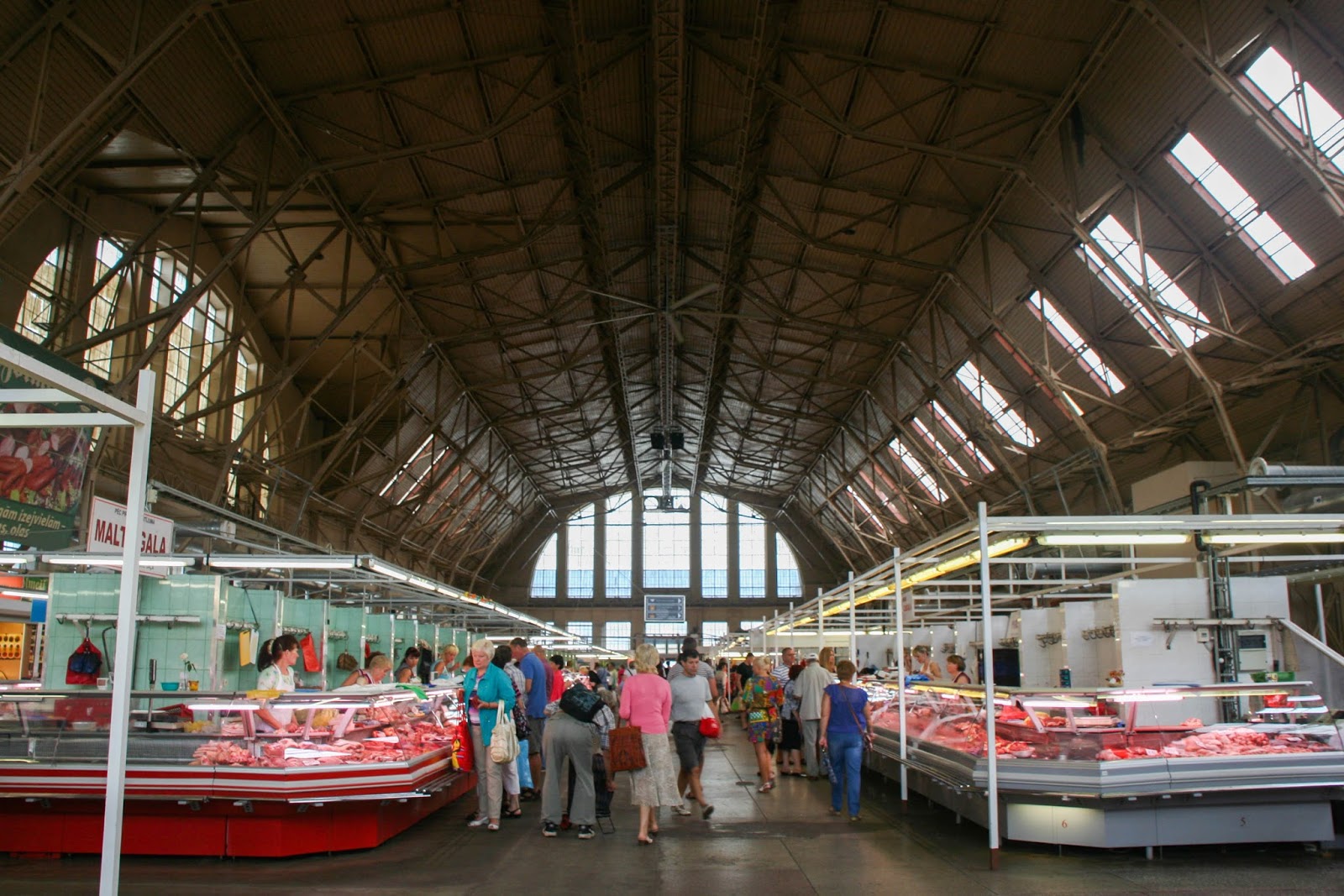

Inside the stalls are a huge butchers market, a huge fish market, more produce, and some random but delicious food stalls.


One nice thing about the market is that it was very busy with locals... though I was surprised to find myself hearing primarily Russian being spoken.  I even found it was best for me to inquire in Russian, which is unusual since Latvian is the country's most widely spoken language and most Latvians also speak very good English.  This had me wondering right away why the market was so Russian dominant.


The spreads were just awesome though... my mouth still waters over some of the products on sale there.


I loved this presentation too, with salmon heads holding their tails in their mouths sitting over a tub of all the spare trimmings and other bits that are just oh so good for flavoring a fish soup or stew.


Then there were the honey stalls with all their beeswax sculptures, candles, and other products.


The market is huge and well worth seeking out for a wander through if you ever find yourself a tourist in Riga.  Definitely come with an empty stomach and eat your way through it too!


However, I found out later that many ethnic Latvians don't actually go to the big market, and it has to do with all that Russian I heard being spoken there.  You see, most Latvians aren't big fans of Russians in Riga.  The reasons for this are complex, having to do with a lot of 20th century history that has bled over into modern geopolitical tensions.


This statue is one of those stark reminders of Latvia's past.  The statue is from the Soviet era and commemorates the Latvian Red Riflemen... the Latvian Riflemen were a unit of the Russian and then Soviet armies.  They were elite, some even serving as Lenin's personal bodyguards.  I'm sure there is some Latvian pride in having an elite fighting force formed from your nation's finest.  However, the issue is that they were formed under Russian occupation.  Supposedly, this statue is quite controversial in Riga, as it is symbolic of these conflicting ideals.  It definitely is reminiscent of Soviet style, and there is just something oddly menacing about the way the imposing figures are looking in all directions, as if they want to remind you that the guards are always watching, which of course is great from a national defense standpoint but not so much at all when living under a brutal secret police.  I have to admit that I'm happy that Riga has left the statue standing.  It is a powerful reminder of history and a true relic of a different and important era in human history.  Though I also understand some Latvians resentment of the statue, as it represents so much that haunts them from the Russian/Soviet occupations.


Standing across the old market square (not to be confused with the big "new" market described above) from the Red Riflemen statue is this dark, ominous block of a building, which strikes a stark contrast to the beautiful buildings all around it.  Latvians remember their history, and the location of the Latvian Occupation Museum stands as testament to that.  Seriously, this museum sits at the heart of their capital city, putting it right at the heart of the nation as well, a nation that will never forget what and how they have suffered.


Poland, Sweden, Russia, the Soviet Union, and Nazi Germany have all forcefully taken and subsequently occupied Latvia throughout the past 500 years.  So it's no real surprise that Latvians take occupation seriously and consider the most recent sets of occupation, which lasted over 50 years during the 20th century, as a still festering sore from their nation's history.  The museum itself is powerful, though it only focuses on the most recent of occupations, those under the Soviets and Nazis since 1940.  The building itself is an old Soviet bunker, and it was left standing as yet another reminder of the darker times in Latvia's past.  Within, you will find a detailed and graphic accounting of the occupations, from the systematic eradication of "undesirables" under the Nazis to a true state of fear under Soviet rule with their dreaded and brutally over-effective secret police.  Really the only thing remotely near a bright side of the whole place are the parts about the Latvian resistance.  Especially since members suffered terribly whenever they were caught, the resistance to occupation speaks wonders about the strength, pride, and resilience of Latvian people.  At its height, the resistance formed a national partisan movement 10s of thousands of people strong, and it remained active fighting and dying for Latvian freedom for over half a century.


With the ghosts of decades and decades of occupation still haunting the nation, national pride is strong in Latvia.  The deep red and white flag flies high all over the city, as does the European Union flag.  After being forced into the Soviet Union, the Latvians seem quite satisfied with a Union that they actual chose to be in.  Though it is sad how few actually trust that the EU and even NATO will offer Latvia any protection in the event of Russian aggression or invasion.  Being an idealist, I like to think differently, especially from NATO, however when you look at history (like Poland 1939 for example), treaties are so easily forgotten when full-blown war is the only other option.


I was very lucky on this trip, and I managed to make friends with a group of Riga locals.  We ended up drinking and talking until well after 4am.  From them, I gained some very interesting insights on some general characteristics of Latvian people... many are strong and proud yet very reserved.  Quite interestingly, one thing that came up repeatedly was a fear of spies; with all of my questions (especially about what people thought about the Russian/Ukrainian conflict), I was asked multiple times: "Are you sure you are not a spy?"  They explained that this question and general lack of trust in strangers stems from decades of living in a police state, first under the Soviets, then the Nazis, then under an even more brutal and oppressive Soviet regime.  Imagine worrying that if you say something "wrong" in public, anything that might make you sound like you disapprove of the Soviet system or the Communist Party or like you are part of the resistance or sowing dissent, you might be overheard by a government informant or undercover member of the secret police.  If you were overheard by such a person, it wouldn't be long before you actually disappeared; either to be tortured in some secret police headquarters basement or worse, sent to a Siberian gulag or just outright executed.   So, when asked about Ukraine and finally convinced that I was not a spy, the general consensus was that Latvians were fearful of the latest round of Russian aggression (both in Georgia in 2008 and now in Ukraine).  Considering the fact that over 1/4 of the population in Latvia is ethnic Russian, the "excuse" that Putin kept giving about protecting ethnic Russians in Eastern Ukraine just struck too close to home for Latvians.  However, one of the guys hanging out with us actually was ethnic Russian.  He was hanging out with a group of ethnic Latvians, and they were all quite obviously great friends.  When asked about all that, he said proudly that he associated himself first as Latvian and only Russian by descent; he claimed he would fight proudly as a Latvian against any Russian invasion.  I hope most of the rest of the Russian-Latvians are like him.  Being from a nation of immigrants, I think it is easier for me to think this way, and I respect that things like this can be more complicated in Old World Europe.

Anyway, back to happier things: the bars and nightlife in Riga were fun... very, very fun.  It is a thriving and energizing scene, with bars that don't seem to ever close, late night cafes and beer patios spilling out onto the streets, bumping music and pulsating dance floors, and tons of vibrant young people enjoying it all.  Riga is an epic city to party in.


The cafe and street pub scene is also great in Riga; I highly recommend seeking this street out over by the Swedish Gate (pictured here).  Turn 180 deg from how this pic was taken and you see a whole lineup of cafe tables and seats setup right down the street.  It's a perfect place for taking in a morning tea or afternoon beer or wine while watching the mix of tourists and locals go by.


Riga also has plenty of nice, unique little galleries and boutique shops.  The art tends to be very warm and cozy and organic... like something a hobbit would like.


Like so many great cities, there is an overall appreciation for finer touches of class and charm.


Another reminder of the past... the Lada was a popular Soviet car.  This one was in remarkably good shape, and I love the color... so very not-Soviet!  The row of flowers against the old wall was also very nice.


This statue was outside of one of the big cathedrals in the Old City.  They definitely have a sense of humor.


And of course... food.  The food I ate in Riga was just awesome, with everything being obviously very fresh, local, and seasonal.  This trout dish was my favorite by far though... it was perfectly cooked and felt so incredibly healthy.  The veggies were bursting with flavor as was the tomato and herb garnish.  And the local beer was malty and delicious.

I loved Riga, and I'll do my best to get back there again.  But this isn't over yet... my next post is on Riga's amazing architecture.

21 June 2015

Moscow, Russia


I have to admit: I was quite nervous and hesitant to embark on my fourth trip to Russia.  It was August 2014, and only a couple weeks earlier, Malaysia Airlines Flight 17 had been shot down over insurgent territory in Eastern Ukraine.  Even then, the evidence was pretty convincing that Ukrainian rebel forces had shot the plane down intentionally.  The missile system used to shoot down the plane was Russian, and more troubling, it is still not clear if Russian military forces, which are known to be directly arming and fighting with the Ukrainian rebels, were actually present during the shooting.  Because of one missile, 298 people died horrifically, their bodies and personal belongings raining down with the shattered wreckage of the plane over farm fields and villages in Eastern Ukraine.  Like so many others around the world, I was devastated by this news.  I thought of those poor people and their families.  Quite honestly, I also thought about myself.  I fly a lot, and I never thought at all of my plane being shot out of the sky by militants, especially not over Europe!  Between this event and Russia's forceful annexation of Crimea earlier in the year, I debated canceling my trip to Russia outright, mostly in protest (not wanting to spend any money supporting the government there).  However, I was convinced not to cancel due to the nature of my trip: it was for a scientific meeting, one with a history and ideal of bringing Western and Russian scientists together despite any major political differences between their home countries (think back to the heart of the Cold War).  Still, with relations between the USA and Russia diminishing so quickly, I would be lying if I said I wasn't very anxious about the trip.

Looking back, I'm glad I went.  It was a very unique time to be in Russia, and I hope this post reflects that.  I was shocked to find Moscow to be mostly in a state of blissful ignorance about just how serious the international situation was becoming and how bad that would be for their economy and lives in the foreseeable future.   Like so many ostriches with their heads in the sand, most of the Muscovites I saw were just going about their business in their everything-new, lavish, and increasingly Western-styled ways.  They were going out to eat at posh, hip cafes and restaurants, drinking fancy cocktails and import craft beers at the bars and clubs, celebrating the good life in the streets, attending the ballet and operas and concerts, and just enjoying the summer weather.  They seemed completely oblivious to the crumbling state of world affairs around them, the very base of which was being jackhammered by none other than their very own national leadership.

This post is about contrasts, the differences between a) what Russia was striving for, and what most every Russian still wants: peace, prosperity, and the good life; and b) what Russia is now apparently charging towards like a raging bull: a return to Cold War tensions and oppression in an ultra-nationalist state under a tyrannical autocrat.


First, the good life.  Moscow has brightened up noticeably and gentrified immensely in the three years since I was there last.  After arriving very early on a Saturday morning, I headed for one of my favorite places to take a morning stroll in the Russian capital: the Old Arbat Street.


The Arbat has had a bit of a facelift since I was there last.  It is still as charming as ever though, with its grand old buildings and great little sidewalk cafes.  The Arbat is a pedestrian only street, which makes it quite a relief compared to most of the rest of the city.


There were plenty of other folks out enjoying the lovely summer Saturday morning.  This is a popular spot for Muscovites and tourists alike.


This was new... they really are everywhere.


I don't recall this one from the last visit either... yes, that's Dunkin Donuts for anyone that either isn't familiar with the brand or can't read Cyrillic to confirm it.


The Arbat is a charming place, and Moscow has definitely embraced that charm and nurtured it.  The street is apparently a real estate hotspot too... no surprise there.


Many Russians love to read, and there is a strong sense of pride in Russia's literary history.  I've been informed many times how wonderful Russian literature is, as read in its native language, with its delightfully quirky and witty double entendre prose that is so achievable in Russian grammar.  Ask any well educated Russian who their favorite Russian author is, and you're in for an earful of nearly worshipful detail.  Education and literacy are held in high esteem throughout the country.  Great Russian intellectuals from history are regarded in almost heroic repute by common contemporary Russians.  I wish we could say the same here in the States... 


Performance arts are big in Moscow too, which is undeniably a highly cultured city.  Ballet, opera, and theater reign supreme, with the top performances being held at the Bolshoi Theater (which is not the one pictured here by the way).


There is a graffiti wall along the Arbat too... the Arbat is popular with artists.  You can find many out selling paintings along the street.


Knowing how much I love architecture, you'll understand that I simply can't do a post on Moscow without including a few of the Stalin Skyscrapers.  These Soviet-era behemoths make up some of the most visible landmarks in Moscow's skyline. 


These grand relics are quite representative of what I've found to be a somewhat common Russian characteristic, showcasing a powerful and gilded image.  If you wonder what I mean by that, just take a look at how so many Muscovites dress and decorate themselves or the cars they drive around in.


The tallest of the Stalin Skyscrapers is the main building of Moscow State University, named in honor of Mikhail Lomonosov, an 18th century scientist who is depicted in the statue seen here.  Again, this goes with what I was saying above about the Russian respect for education: the tallest of the existing skyscrapers (the only one taller was meant to house the Soviet state administration itself but was never built) houses a university!


And at Moscow State University, more signs of recent Russian prosperity: this building, the new library, is one of three huge new additions to the University.  There is that powerful, gilded look again...  supposedly the buildings were the gracious "donation" from the mayor (or the city?), who quite conveniently also has a major share in the construction company that got the contract to build them (and many other enormous projects around the city).  I'm sure that is just coincidence though.


Back in Central Moscow and on to Kuznetsky Most, another great place to wander around on a sunny weekend.  Kuznetsky Most is another famous shopping street dating back to the 19th century.  It too has some cool shops and good cafes, restaurants, and bars to explore.  Moscow is a very metropolitan city, arguably up there with New York, Paris, London, and Tokyo.  Muscovites seemed to be enjoying a healthy economy, as you can see from the bustling street scene here.


The pleasures and benefits of a healthy economy were clear after dark too.  During the evening and well into the night, cafes, bars, and nightlife were booming around the center.  Moscow is clearly a city that never sleeps...


For a boozy brunch or afternoon tipple on a sunny Sunday, you can also check out the very popular and uber chic bars along the river across from the Christ the Savior Cathedral and by the Peter the Great memorial (seen here on the right).  


Another example of Russia's recent prosperity is the new financial district, or the International Business Center... because every great city needs glass and steel skyscrapers, right?  They have been working on the new district for years now, but it is amazing to see the progress since last I was there.  They are essentially building an entire North American style downtown in only a few years.


Like I mentioned above, there are plenty of luxury cars on the streets.  Moscow ranks third on the list of world cities with the most billionaires.  Interestingly, it doesn't come in on the rankings at all for multi-millionaires (net worth of more than $30M) and falls to 20th in the world for lowly millionaires.  That is a prime indicator that there is a very uneven and top-heavy balance of wealth in Russia, which should come as no surprise to anyone really.


Yet more signs of prosperity, there were cranes all over the city.  And construction booms are not cheap...


So, it seems clear that Moscow has appreciated its recent prosperity from a healthy economy and that average Muscovites were enjoying the benefits of typical Western European lifestyles warmer international relations (I've seen more Russian tourists elsewhere in Europe over the past two years than just about any other nationality other than maybe Chinese).  But what about the Kremlin...


Russia is an immensely complex place, but one thing is terribly clear: Russia only has one true boss and his name is Vladimir Putin.  Within just a few weeks after the closing of "Putin's Games" in Sochi, when Russia dazzled the world and seemingly came out of its xenophobic shell to host the Winter Olympic Games, Russia had played a major part in fomenting a devastating civil war in Ukraine and had illegally annexed the Crimean Peninsula.  Within a month, foreign views of Russia went from pleasantly hopeful to terribly outraged.  What was worse was Russia's blatant denial of their involvement in the rebellion in Eastern Ukraine (primarily in Donnetsk and Luhansk) and (at first) the seizure of Crimea.  Putin spun a web of deceit and lies and pulled one hood after another over the eyes of the international community.  What is happening to Ukraine is appalling... it seems so clear that it is Putin punishing Ukraine for their desire to join the EU (and possibly NATO).  He and the Russian military have literally broken the Ukraine.  That sends a loud and terribly clear message to Russia's other neighbors: This is what happens when you even think about joining with our historic enemies.

The thing that frustrates me most are questions like: How could we ever let the world return to Cold War conditions?  Where has the world gone wrong?  What could we have done to improve relations with Russia and prevent this?  Why do Putin and Russia seem so vehemently against improving relations with the rest of Europe and the United States?  Why are Putin and Russia so seemingly willing to alienate themselves from the rest of the world (particularly economically)?  And most disturbing of all: How far will Putin go?  The next portion of this post focuses on the ugly side of modern Russia... though modern isn't such a good word here since it really reflects "business as usual" from generations of totalitarian autocracy and Soviet rule in the past.


This relic of the Soviet era is still in business and going strong. TACC (pronounced "tass") is the Russian News Agency; it is, and always has been, owned and operated by the Russian government. This, plus the state-funded Russia Today television news network are shining examples of state controlled media and blatant propaganda. At least in the free world, media outlets are privately owned, so they tend to cater to corporate interests, often also favoring particular political views, but always favoring their source of profitable income: advertisers. Not so the case in Russia (and many other countries), where the most powerful and prolific major media outlets are state owned, and freelance journalism or reporting anything that makes the state look bad can land you in jail (if you're lucky) or in a coffin (if you're not). I watched Russia Today (RT, which also does an English broadcast that you might even get with your cable service) while I was there and was interested to hear their take on what was happening in Ukraine. RT's reports focused on the innocent civilians that were being forced out of their homes by the aggression of the Kiev government, which RT reiterated as often as possible was illegitimate, as well as those killed and maimed by Ukraine military attacks on the liberation force fighting to restore the legitimate president to power. RT didn't mention anything at all about those people being forced out, maimed, and killed by the separatists. Nothing at all was discussed about any Russian forces on the ground in Ukraine, nor how the rebels were being supplied and trained by the Russian military. They also mentioned extremely little of the Malaysian Airlines flight that had been shot down. The RT reports focused entirely on the plight of the Ukrainian people who were suffering under a tyrannical illegitimate government in Kiev and were crying out to Russia for help. 

Seeing both sides of the news, I understand and recognize that often the Western media casts Russia in a very negative light and rarely reports any good news from or about Russia; that is not fair or right. However, Russian state media is worse. It tells half-truths and blatantly ignores anything that doesn't push Putin's own agenda. At least in the USA, Canada, and Europe journalists can openly and freely report against those in power without fear of punishment or death. Russian journalists can't say the same at all. For example, read about Anna Politkovskaya; she is one of many journalists who have been mysteriously murdered after reporting against the state.


In Russia, propaganda isn't just on the TVs either... it's also in public "works of art".  This statue quite clearly represents the blinders of youth and innocence in a world full of devious and dangerous malefactors.


Each sin and vice had a character and was labeled below in both Russian and English.  Drug addicts, prostitutes, thieves, alcoholics, idiots, warmongers, cheats, the corrupt, the unjust, arms dealers, the indifferent, and even bad scientists were all represented surrounding and tempting the blind, golden children frolicking in the middle.


I just loved this one for war; check out the headpiece on that bomb... surely Micky Mouse isn't meant to inspire any kind of prejudice about any particular country or economic model, right?   *(careful with the sarcasm in that last one)*  There was just so much that was just completely hypocritical about this statue being in Moscow.  Who is fomenting war in Ukraine?  Who is stealing territory from its neighbors?  Who is profiting most from arms exports? (A: USA and Russia top that list) Who's courts serve the highest bidder and offer no true justice? And worst of all, how many Russians are indifferent to or too fearful of speaking out against so much they must know is wrong.


The propaganda machine of the Kremlin is nothing new... on this trip, I finally made it out to the VVTs.  The VVTs - or ВДНХ in Russian, an acronym translating to "Exhibition of National Economic Achievements" - are relics from the Soviet era that occupy a huge plot of land in Northern Moscow.  This complex consists of a series of displays and buildings showcasing the glorious advancements of the Soviet economy and some of the wonders of the Soviet empire.


The signs of Soviet communism are everywhere here, and really, the VVTs are an incredible open air museum for Russian and world history!


Entering through the main colonnade, one sees this impressive structure straight ahead along the Alley of Fountains.  This building, topped again with those tall hood ornaments familiar from the Stalin skyscrapers, is the House of the Peoples of Russia.


Of course, there is a statue of Lenin front and center.


Inside, there are more symbols of Soviet Communism all over.  Though the place has a very abandoned and neglected feel to it...


It has a distinct feel of faded glory... a glory that Putin is currently striving to recover?


I wonder if some of those heads and faces have been removed purposefully... 


On the other side of the House of the Peoples of Russia, lies the Fountain of the Friendship of Peoples.  The 16 gilded maidens around the fountain each appear in one of the traditional national outfits of the 16 Soviet republics.


Around the rest of the complex are a series of pavilions, each of which is devoted to a particular Soviet republic (the example above is the Armenian Pavilion) or aspect of Soviet scientific advancement.  Nowadays, the pavilions host a series of shops, some of which actually are themed based on that of the pavilion (for example you can get Armenian wine and cognac samples in the Armenian pavilion).


Near the middle of the entire complex lies the Ukrainian Pavilion, which is one of the largest and most ornate as well.  Again, this is just ironic considering the current state of affairs between Russia and Ukraine.  The nation that was once the closest and dearest ally to Russia, holding a place of honor at the VVTs, is now being torn apart by Russian aggression and influence.  It is a cruel irony that Russia claims its actions are for the benefit of their old friend, Ukraine.


I found this one interesting, Aeroflot is still very well in business... though I don't think they'll be bringing back that paint job on the modern fleet anytime soon.  Unlike during the Soviet era, Aeroflot is no longer run by the state, but instead is a semi-privately run (the Russian Government simply owns a majority of the shares) corporation.


The VVTs also includes the Russian air and space museum, the Memorial Museum of Cosmonautics, which sits below the Space Obelisk, an epic monument to spaceflight.  I have to say though that the symbolic parallel between this statue and the buk missile that shot skyward towards the the Air Malaysia flight over Ukraine is just too terribly obvious not to mention explicitly.


Rightfully so, no Soviet monument to spaceflight would be complete without some heroic representation of Yuri Gagarin.  Here, his symbolic step up sets him completely apart from the rest of the humans depicted.


Inside, the museum is full of an incredible collection that would make any space enthusiast fully delighted. Pictured here is a Soyuz capsule, which is still in use today. By the way, the reason why you see the word Soyuz ("Союз") all over the old Soviet monuments as well is because "soyuz" means "union" in Russian.


At the far end of the complex sits the monumental pavilions to Soviet science, such as electricity and power, transportation, and more on space. Supposedly, one of these pavilions used to house an atomic pile of radioactive Uranium rods that were actually close enough together to be visibly glowing within a large tank of water.


Then there is this Vostok rocket mounted on a replica launch platform.  Derived from an ICBM, the Vostok series carried the first human-built satellite (Sputnik) and the first human (Gagarin) into space.


There is also a model Buran, the Russian version of the space shuttle.  A Buran shuttle flew in space in 1988, but never with a crew of cosmonauts.


I put this picture of the backside of this impressive statue on here purposefully, since it represents the direction Soviet communism, the Cold War, and Russian aggression and war-mongering should be walking: away.  The Worker and Collective Farm Girl monument is actually really impressive to see in person... made entirely of huge, hand-sculpted stainless steel blocks, each of the two figures weighs in at a whopping 60 tons!


Anyway, back into the subway... let's not end this post on a sour note.


The Moscow Metro is an enormous and fully functional work of art.  The system runs frequently and efficiently and its stations are elaborately decorated and uniquely themed.  This is a picture of one of the 36 bronze statues and red marble that decorate the Ploshchad Revolyutsii station, commemorating the defense of Soviet power and progress.


Again, to end on a high note, let's discuss the wonderful thing that is Russian food and drink!  I can do no justice to such a complex and sophisticated culinary culture in only a few photos and words, but I'll highlight some of my favorites.  It is no stereotype that vodka is a staple of Russian drinking culture, and there is also much spillover from the love of vodka into Russian cuisine.  The partnership between food and drink is embodied in what Russians so endearingly have termed "chasers": small bites of food meant to accompany shots (many shots) of vodka.   One great place to sample some vodka and chasers is Kvartira 44 (KB. 44) in the Beliy Gorod.  My favorite there was a sampler of salty, savory meat and fish spreads with several different types of rye and black breads.  Also great was the platter of pickled veggies and smoked, fatty meats shown above.  Due to the long, cold winters, preservation has been historically key to Russian cuisine, which explains the great assortment of pickled, fermented, and smoked food choices.  KB. 44 offers all this in the coziest and most intimate of environments, one that is great for intellectual discussions with intelligent friends or finding a quiet corner for yourself to tuck into a good book.


Next up, to continue your adventure, an old classic is Cafe Mayak, which is a conveniently short stumble from KB. 44.  Whether you are there to enjoy a coffee and small bite in the morning or wander in for some of the heavier stuff and chasers late at night, Cafe Mayak offers a great environment for you to enjoy your exploration of Russian food and drink.  


If you really want to go all out for the super-fancy, ultra-Russian fine dining experience, you can head over to Cafe Pushkin.


Inside, the cafe is wood paneled in classic European style.


And the food is simply awesome.  We started with vodka and chasers.  Pictured here is herring in a fur coat (pickled herring with potatoes, dill, and onions)... definitely my favorite chaser of them all!  The flavors all complement the clean vodka so, so, so well!  The rest of the menu is great at Pushkin too.  One of my favorite parts of Russian cuisine is soups... they have so many different types, and they are all good.  For this trip to Pushkin, I enjoyed shchi for the first time, which is a classic Russian cabbage and vegetable soup (Cafe Pushkin's version also has pork to enhance the flavor of the broth).

So, back to the main theme of this post: what is Russia going to choose?  Peace and prosperity or empire and war?  Whichever the Russian people do decide, since the decision ultimately lies with them, the rest of the world will be inevitably and lamentably pulled with them.  I am lucky to consider many Russians as great friends, and I have a great appreciation for Russian food and culture.  So, I certainly hope that we can somehow avoid returning to another era of Cold War between Russia and the West (or at this point, should I really say "the rest"?)